Free practice questions for the English Language Proficiency Assessments for California, with an explanation for every answer.
Updated , for the 2026–27 Summative ELPAC, given between February 1 and May 31, 2027.
Every grade band from kindergarten to grade 12 is here. Pick the student's grade below and start straight away: there is no sign-up, listening questions play a recorded passage, and every answer comes with an explanation of why it is right and why the others are wrong.
Each grade band has two mixed practice tests and section practice in all four domains: listening, speaking, reading and writing. The questions are original, written to match the published ELPAC task formats, because knowing those formats is most of the benefit of practice. A student who has seen a task type before spends their time on the English rather than on working out what is being asked.
One question each from three grade bands, the way they appear in practice. Decide on an answer, then open it to see why it is right.
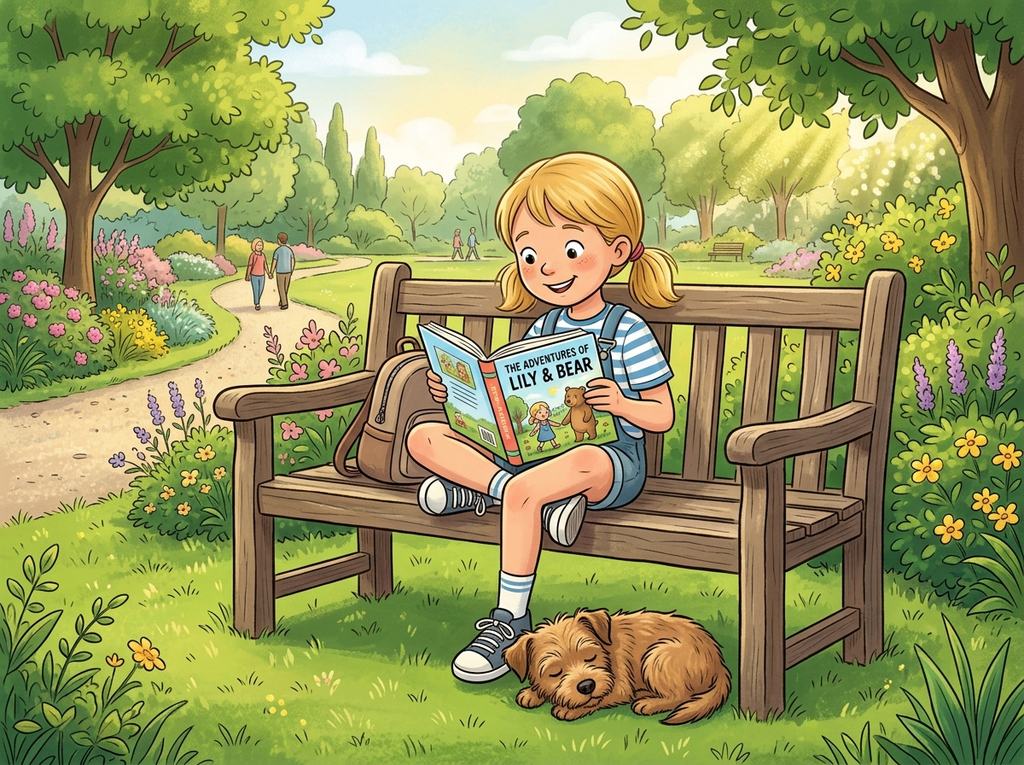
Grade 1 reading: Read and Choose a Sentence
Read image description
A girl sits on a wooden bench in a park. An open book is in her hands. A small brown dog is asleep by her feet.
Read the four sentences. Choose the one that best describes the picture.
Which sentence best describes the picture?
AThe girl runs with her dog.
BThe girl reads a book on a bench.
CThe dog sits on the bench alone.
DThe girl sleeps under a tree.
Show the answer
B. The girl reads a book on a bench. — The Read and Choose a Sentence task asks a child to match a whole sentence to a scene, which is a step up from matching single words. Each wrong choice changes one part of the scene: who is there, what they are doing, or where. Check the choices with the child one piece at a time — who, doing what, and where.
The girl runs with her dog. — Both the girl and the dog are in the picture, but neither is running; she is sitting and the dog is asleep.
The dog sits on the bench alone. — The dog is in the picture, but it is asleep by her feet and the girl is on the bench with it.
The girl sleeps under a tree. — Sleeping is in the picture, but it is the dog that sleeps, and the girl is on a bench, not under a tree.
Listen to the conversation between Leila and Nathan. Then answer the question.
Garden Club at One O'Clock
Listen to Garden Club at One O'Clock0:25
Press play to listen. You can pause, rewind, and replay as often as you like.
Show transcript
Leila: Nathan, are you coming to the garden club after lunch?
Nathan: I want to, but I have to finish my math corrections first. Mr. Reyes said they are due today.
Leila: We are planting the tomato seedlings at one o'clock. Could you bring the watering cans from the science room on your way?
Nathan: Sure. If I am late, start without me and save me a row.
Choose the best answer.
What does Leila ask Nathan to do?
AFinish his math corrections before lunch
BPlant the tomato seedlings by himself
CSave a row in the garden for her
DBring the watering cans from the science room
Show the answer
D. Bring the watering cans from the science room — This question tests listening for a request, which in English is often phrased as a question rather than a command. Leila's request is "Could you bring the watering cans from the science room on your way?" The other choices all use words that appear in the conversation, so the student has to track who says what, not just recognize familiar phrases.
Finish his math corrections before lunch — The math corrections are Nathan's own reason for running late, not something Leila asks him to do.
Plant the tomato seedlings by himself — Leila says "we are planting," so the club is doing the planting together.
Save a row in the garden for her — Nathan is the one who asks for a row to be saved, and he asks it of Leila.
Grades 6–8 reading: Read a Short Informational Passage
Read the notice. Then answer the questions.
Notice: Changes to After-School Tutoring
Beginning February 2, the after-school tutoring center will move from Room 12 to the library annex. Tutoring runs from 3:15 until 4:45, Monday through Thursday. Students who want help with math or science no longer need to reserve a place; they may simply come in. Writing conferences are the exception and must still be booked through the online form at least one day in advance. The late bus leaves the north lot at 5:00. Any student still on campus after 4:45 without a supervising teacher should wait in the front office until the bus arrives.
Choose the best answer.
According to the notice, what must a student do to get help with a writing assignment?
ACome to the library annex any afternoon between 3:15 and 4:45
BSign up in Room 12 before school
CBook a conference through the online form at least a day ahead
DAsk a teacher to stay and supervise after 4:45
Show the answer
C. Book a conference through the online form at least a day ahead — This tests a common structure in school notices: a general rule followed by an exception. The notice announces that math and science no longer need a reservation, then immediately says 'Writing conferences are the exception and must still be booked'. Students who read only the first half of that pair choose the drop-in answer, so the skill to teach is watching for words such as 'exception', 'however' and 'still'.
Come to the library annex any afternoon between 3:15 and 4:45 — Dropping in is now allowed for math and science; writing is the one kind of help the notice carves out.
Sign up in Room 12 before school — Room 12 is the old location, and the notice says the center is moving out of it.
Ask a teacher to stay and supervise after 4:45 — Staying past 4:45 is covered by a separate rule about supervision and has nothing to do with booking help.
How this site differs from the official ELPAC practice test
Do both if you can. The official practice and training tests are the only way to see the real test interface; the practice here is quicker to start and explains every answer. How to open the official practice test, step by step.
Official practice test
This site
Getting started
A guest sign-in on the CAASPP and ELPAC student site: choose a grade, a test and settings, then sign in.
Pick a grade and start. No sign-in or account.
Right and wrong answers
No score and no feedback on screen. Answers are in a separate scoring guide PDF for each grade band.
Marked as you go, with the reason for the right answer and for each wrong one.
Listening
Recorded audio inside the test.
Recorded audio, replayable, with the transcript underneath.
Speaking and writing
Scored with the scoring guide and rubric PDFs, by an adult.
Prompts with rubrics and sample answers, and optional practice feedback on writing.
The real interface
Yes: the same screens, tools and buttons a student sees on test day.
No. Use the official training test for that.
Where to find the official ELPAC materials
This site is independent, and the practice questions here are original. The California Department of Education publishes its own practice and training tests, and they are worth doing as well — they are the only place to see the real interface a student will sit in front of.
Each part of the test uses a small set of repeating task types. Not every task appears at every grade, so the applicable grade bands are listed with each one.
Reading
Read-Along Word with Scaffolding(grades K) — With help from the test examiner, the student gives the letter names and the first letter sound of a word.
Read-Along Story with Scaffolding(grades K) — The student follows along while the examiner reads a short story aloud, with pictures for support.
Read-Along Information with Scaffolding(grades K) — The student follows along while the examiner reads an informational text aloud, with pictures for support.
Read and Choose a Word(grades 1) — The student reads three words and chooses the one that matches a picture.
Read and Choose a Sentence(grades 1, 2, 3–5) — The student reads three or four sentences and chooses the one that best describes a picture.
Read a Short Informational Passage(grades 1, 2, 3–5, 6–8, 9–10, 11–12) — A brief factual text — a notice, a label, a set of instructions — followed by questions.
Read a Literary Passage(grades 1, 2, 3–5, 6–8, 9–10, 11–12) — A short story or scene, with questions about characters, events and what words mean in context.
Read an Informational Passage(grades 1, 2, 3–5, 6–8, 9–10, 11–12) — A longer factual text, with questions about the main idea, supporting details and vocabulary.
Read a Student Essay(grades 3–5, 6–8, 9–10, 11–12) — An essay written as if by a classmate, with numbered sentences. The student finds the sentence containing the error.
Vocabulary and Grammar in Context(grades 3–5, 6–8, 9–10, 11–12; extra practice, not an official task) — Extra practice, not a separate task on the real test: a sentence with one word missing, testing the vocabulary and grammar the passages assume.
Listening
Listen to a Short Exchange(grades K, 1, 2, 3–5, 6–8, 9–10, 11–12) — A two-turn exchange between two speakers, followed by a question about it.
Listen to a Classroom Conversation(grades 1, 2, 3–5, 6–8, 9–10, 11–12) — A multiple-turn conversation between two speakers, followed by three questions.
Listen to a Story(grades K, 1, 2, 3–5) — A multiple-turn conversation or narrative, followed by three questions.
Listen to an Oral Presentation(grades K, 1, 2, 3–5, 6–8, 9–10, 11–12) — A presentation on an academic topic, followed by three or four questions.
Listen to a Speaker Support an Opinion(grades 6–8, 9–10, 11–12) — An extended conversation in which one classmate argues for an opinion, followed by four questions.
Writing
Label a Picture — Word with Scaffolding(grades K) — The student writes labels for objects shown in a picture.
Write a Story Together with Scaffolding(grades K, 1, 2) — The student works with the test examiner to compose a short story together.
Describe a Picture(grades 1, 2, 3–5, 6–8, 9–10, 11–12) — At grades 1–2 the student writes a short description of a picture. From grade 3 the student expands, corrects and combines sentences a classmate wrote about it.
Write an Informational Text Together(grades 1, 2) — The student listens to a short informational passage, then composes a text about it with the test examiner.
Write About an Experience(grades 1, 2, 3–5, 6–8, 9–10, 11–12) — The student is given a common topic, such as a classroom event, and writes about it.
Write About Academic Information(grades 3–5, 6–8, 9–10, 11–12) — The student interprets information from a graphic organizer and answers two questions about it.
Justify an Opinion(grades 3–5, 6–8, 9–10, 11–12) — The student writes a short essay giving a position on a school-related topic, with supporting reasons.
Speaking
Talk About a Scene(grades K, 1, 2, 3–5, 6–8, 9–10, 11–12) — The student is shown a familiar scene, answers who/what/when questions about it, then gives longer responses.
Speech Functions(grades 2, 3–5, 6–8, 9–10, 11–12) — The student says what they would actually say in a situation the examiner describes.
Support an Opinion(grades K, 1, 2, 3–5, 6–8, 9–10, 11–12) — The student hears about two activities or objects and says which is better and why.
Retell a Narrative(grades K, 1, 2, 3–5) — The student listens to a story told through a series of pictures, then retells it using the pictures.
Present and Discuss Information(grades 6–8, 9–10, 11–12) — The student reads a graph, chart or image, summarizes it, then says whether a claim it makes is supported.
Summarize an Academic Presentation(grades K, 1, 2, 3–5, 6–8, 9–10, 11–12) — The student listens to an academic presentation and summarizes its main points.
What the ELPAC measures
The ELPAC is aligned to the California English Language Development Standards. It reports four performance levels, from Level 1 (minimally developed) to Level 4 (well developed), along with separate composite scores for oral language (listening and speaking) and written language (reading and writing).
There are two versions. The Initial ELPAC is given once, shortly after a student first enrols, to determine whether they are an English learner. The Summative ELPAC is given every year after that to measure progress, and is the one most families are preparing for.
How the test is organized
Questions are grouped by grade band rather than by single grade, so students in grades 3, 4 and 5 all see the same form of the test. Each band has its own passage lengths and task types, which is why practice is organized the same way here.
When the test is given
The Summative ELPAC testing window runs from the beginning of February to the end of May each year. The Initial ELPAC is given within 30 calendar days of a student enrolling. Your school or district sets the exact dates within those windows, so ask them if you need a specific day.
Task types and grade spans follow the California Department of Education Summative ELPAC Domain Information Sheets (2026) for listening, speaking, reading and writing.
No. Released official questions are copyrighted by the California Department of Education. Everything here is original material written to match the published task formats, which is what makes practice useful — the formats repeat, the specific questions do not.
Does a score here predict a real ELPAC performance level?
No. These practice sets are shorter than the real test and are not calibrated against it. Use the results to find which task types a student struggles with, not to estimate a level.
Why are writing and speaking not scored?
On the real test both are scored by a trained person against a rubric. Nothing automated can do that honestly, so rather than invent a score, those sections offer prompts, rubrics and sample responses to work through with a student. You can also get personalized practice feedback on an answer: the rubric level it looks closest to, what it does well, and what to work on next. That is a guide for practice, not a score. Speaking feedback reads only the automatic transcript of what was said, so it cannot judge pronunciation.
Is this site connected to the California Department of Education?
No. It is an independent study resource with no affiliation to the CDE or the official ELPAC program.
Do students need an account?
No. There is no sign-up. Answers to a mixed practice test are kept in your own browser only, so you can pick the test back up where you left off on the same device. Writing is sent out only when you ask for feedback on it, and the text of a spoken answer only when the live transcript is on; neither is kept. The live transcript uses your browser's speech service, which in Chrome sends audio to Google; it is off unless you turn it on.
This is an independent study resource. It is not affiliated with, endorsed by, or connected to the California Department of Education or the official ELPAC program. All questions here are original practice material written to match the published task formats.