ELPAC writing prompts and practice for kindergarten
Writing prompts with a rubric based on the published scoring guides, plus sample responses and optional personalized feedback. Not scored here — writing is scored by a person on the real test.
Write your response in the editor. You can see your word count, use the optional timer, save a draft in this browser, ask for personalized feedback, and compare your writing with the rubric and sample response. It is not scored here — on the real test a trained scorer rates writing.
Prompt 1 of 4 — Label a Picture — Word with Scaffolding — about 3 minutes on the real test
Sit with your child and look at the picture together. On the real test an examiner does this part one to one, pointing to each thing to be named while the child writes.
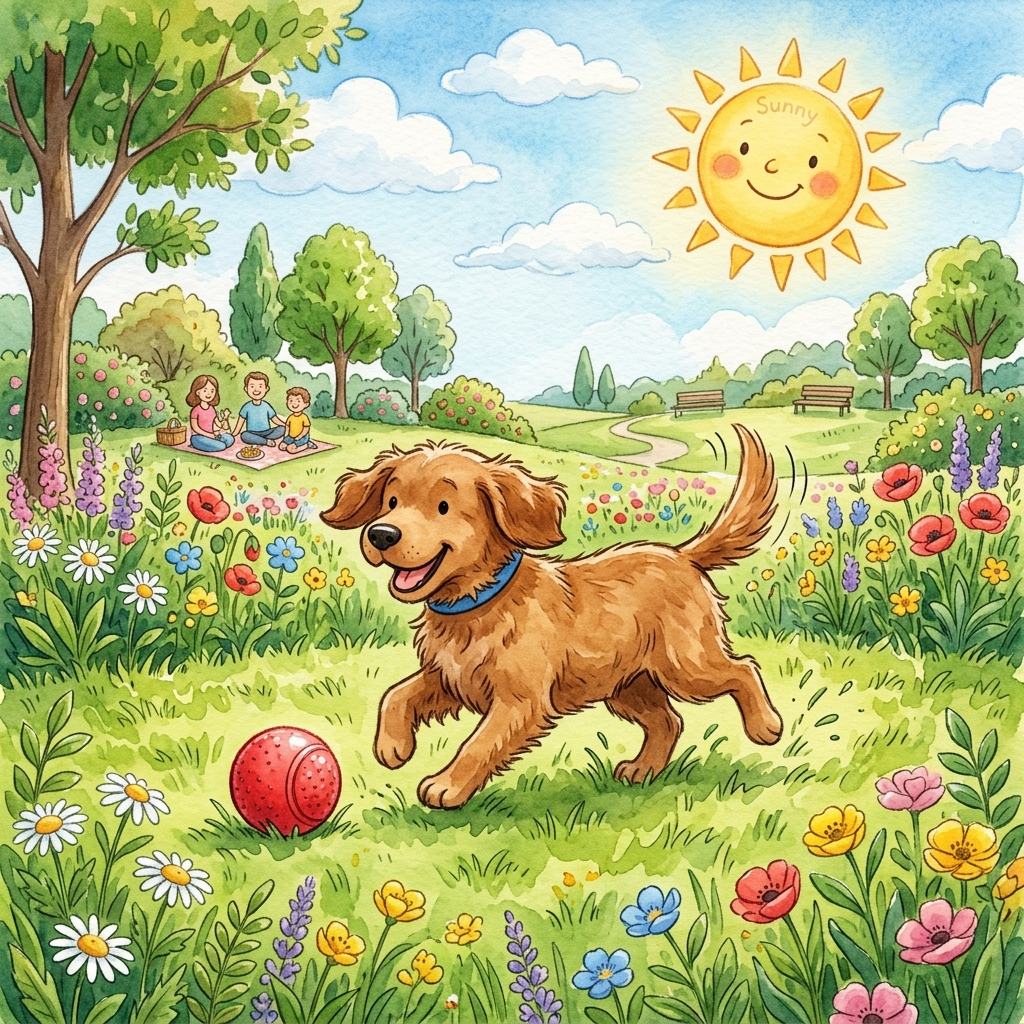
At the Park
Read image description
The picture shows a park on a sunny day.
A big yellow sun smiles in the blue sky.
A brown dog runs on the grass. The dog has a blue collar.
A red ball is on the grass in front of the dog.
There are many flowers. Far back, a family has a picnic on a blanket.
Look at the picture together. Give your child a pencil and a sheet of paper with three empty boxes on it. Then point to and name one thing at a time — "this one is the sun; write sun in this box" — and let your child write. Say each word again as often as your child asks. You hold nothing back and you write nothing yourself.
Write the word for each thing in the picture: the sun, the dog, and the ball.
View the practice scoring rubric
| Level | What it looks like |
|---|---|
| 4 — Well developed |
|
| 3 — Moderately developed |
|
| 2 — Somewhat developed |
|
| 1 — Minimally developed |
|
Show a strong sample response
In the box by the sun your child writes: sun
In the box by the dog: dg
In the box by the ball: bol
While writing, your child stretches each word out loud first — "ddd-ooo-g", "b-b-ball" — and then puts down the letters for the sounds they caught.
All three words are there and anyone holding the picture would know which is which. Dg and bol are invented spelling: your child heard the sounds and wrote the letters that make them, which at five is the sign that the system is working, not an error to fix.
What to look for
- Name one object at a time and wait. A five-year-old looking at a whole picture and a whole page usually writes nothing at all.
- Let your child stretch the word out loud before writing it. Writing at this age is spelling by ear, so the sounds have to be heard before they can be spelled.
- Invented spelling is expected here. Dg for dog and bol for ball show which sounds were heard; do not write the correct spelling over the top, and do not spell the word out for your child.
- A backwards letter is ordinary at five and is not what this task is about. A wrong first letter is worth one more try — say the word slowly and ask what sound it starts with.
- Nothing here produces a level, and at five a level would tell you almost nothing. What you get from this is a list of which sounds your child can already put on paper.
Read next
- How to Prepare for the ELPAC: Effective ELPAC preparation is about steady daily language development rather than frantic test cramming. Here is a practical, domain-by-domain guide for parents and teachers.
- ELPAC Scores Explained: A Summative ELPAC report gives an overall performance level from 1 to 4, plus separate results for oral language and written language. Here is what each part means, and what it does not mean.
This is an independent study resource. It is not affiliated with, endorsed by, or connected to the California Department of Education or the official ELPAC program. All questions here are original practice material written to match the published task formats.