ELPAC speaking prompts and practice for kindergarten
Speaking prompts with a rubric based on the published scoring guides, plus sample responses and optional personalized feedback. Not scored here — speaking is scored by a person on the real test.
Record your answer and play it back—no typing needed. Where supported, turn on automatic transcription to get personalized feedback on what you said. The feedback reads only the transcript, so it cannot judge pronunciation, and it is not an official ELPAC score — on the real test, speaking is scored against a rubric.
Prompt 1 of 8 — Talk About a Scene — about 3 minutes on the real test
Sit with your child and look at the picture together. The examiner points at parts of the picture while asking. You can also read this aloud slowly before you start the questions.
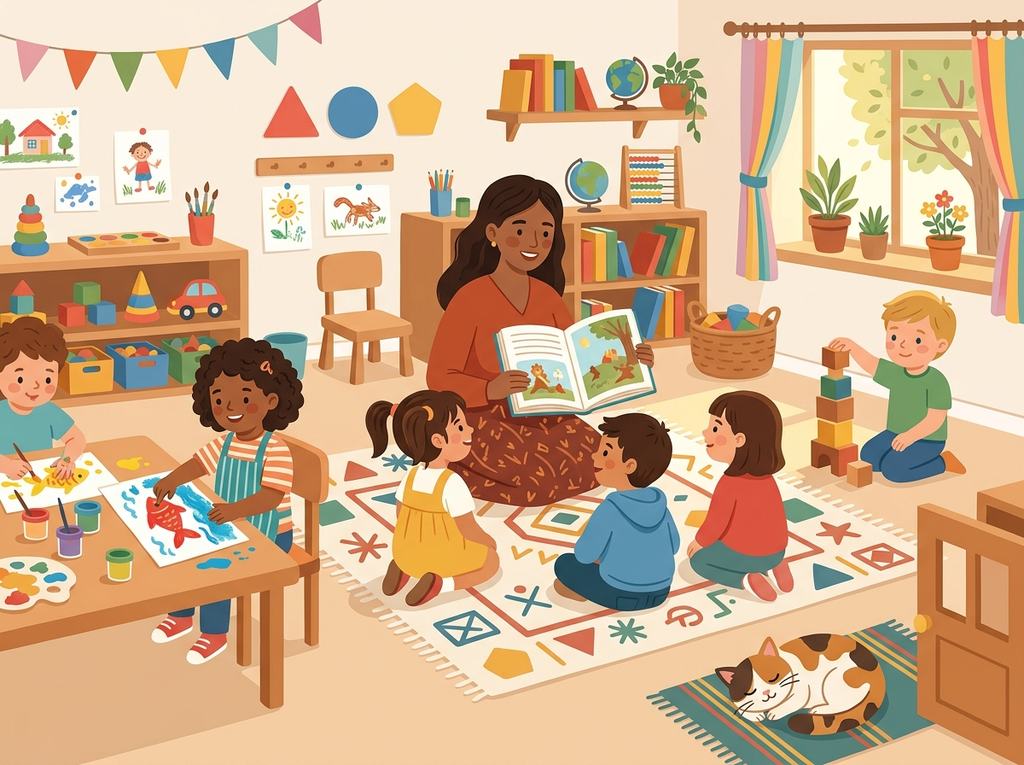
In the Classroom
Read image description
The picture shows a classroom in the morning.
A teacher sits on the rug. She holds a big book. Three children sit in front of her and look at the book.
At a table, two children paint. One of them paints a red fish. There is paint on the table.
By the window there is a box of blocks. A boy in a green shirt puts a block on top of a tall tower.
The class cat sleeps on the mat by the door.
Look at the picture together with your child. Then ask the four questions below one at a time, and wait after each — a five-year-old often needs five or six seconds before anything comes out. Your child answers out loud and writes nothing.
Who is holding the book? What are the two children at the table doing? Where is the cat? Now tell me everything you can see in this picture.
Answer the prompt aloud. After recording, listen back or try another take.
View the practice scoring rubric
| Level | What it looks like |
|---|---|
| 4 — Well developed |
|
| 3 — Moderately developed |
|
| 2 — Somewhat developed |
|
| 1 — Minimally developed |
|
Show a strong sample response
Who is holding the book? — "The teacher. She reading to the kids."
What are the two children at the table doing? — "They painting. One girl make a fish. It red."
Where is the cat? — "By the door. On the mat. He sleeping."
Now tell me everything you can see. — "Um. The teacher and three kids on the rug. And two kids painting and the paint go on the table. And that boy, he have a green shirt, he make a big tower with the blocks. It very tall. Maybe it fall down."
Every question is answered with the right thing, and on the last one the child keeps going and says what people are doing instead of only naming them. She reading and he have a green shirt are completely ordinary at five and do not stop a listener following.
What to look for
- Ask the four questions one at a time and then stop talking. Five or six seconds of silence feels long to an adult and is normal thinking time for a five-year-old.
- A one-word answer is a real answer. Take it, then ask one follow-up — "what is she doing with the book?" — rather than asking the same question again.
- A wrong answer here usually means the picture detail was missed, not that the English is missing. Point to that part of the picture and ask exactly the same question.
- A word from your child's home language in the middle of an English sentence is normal and is not a failure. Say the English word back to them and carry on.
- Nothing here gets a score. The question worth asking yourself is whether a stranger could picture that classroom from what your child said.
Read next
- ELPAC Speaking Test: Task Types & Rubrics: The Speaking domain asks a student to answer out loud, one to one with a test examiner who scores each answer on the spot. Here is what each task type involves, how answers are scored, and how to practice.
- How to Prepare for the ELPAC: Effective ELPAC preparation is about steady daily language development rather than frantic test cramming. Here is a practical, domain-by-domain guide for parents and teachers.
- ELPAC Scores Explained: A Summative ELPAC report gives an overall performance level from 1 to 4, plus separate results for oral language and written language. Here is what each part means, and what it does not mean.
This is an independent study resource. It is not affiliated with, endorsed by, or connected to the California Department of Education or the official ELPAC program. All questions here are original practice material written to match the published task formats.