ELPAC speaking prompts and practice for grades 9–10
Speaking prompts with a rubric based on the published scoring guides, plus sample responses and optional personalized feedback. Not scored here — speaking is scored by a person on the real test.
Record your answer and play it back—no typing needed. Where supported, turn on automatic transcription to get personalized feedback on what you said. The feedback reads only the transcript, so it cannot judge pronunciation, and it is not an official ELPAC score — on the real test, speaking is scored against a rubric.
Prompt 1 of 8 — Talk About a Scene — about 3 minutes on the real test
Look closely at the picture, then speak your answers aloud.
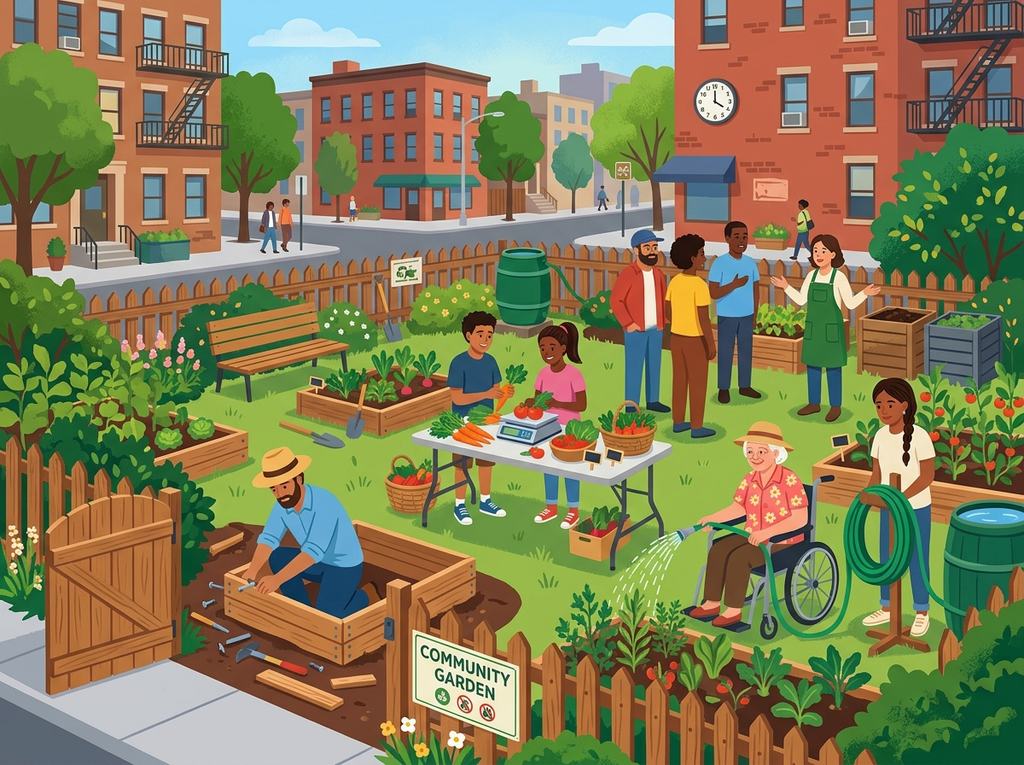
Saturday at the Community Garden
Read image description
The picture shows a community garden on the corner of a city block on a Saturday morning. A chain-link fence runs along the sidewalk, and a hand-painted sign wired to the gate says 'Alameda Street Garden — Compost Workshop Today at Ten'.
Just inside the gate, a man in a straw hat is kneeling to bolt together the last corner of a new raised wooden bed. A cordless drill and a box of screws are on the ground beside his knee.
In the middle of the garden, two teenagers are weighing vegetables on a scale set up on a folding table. One is writing figures in a notebook while the other holds out a crate of tomatoes and peppers. A cardboard sign taped to the table says 'Free — Please Take What You Need'.
Behind them, an older woman in a wheelchair is watering a bed of herbs with a hose, and a small child is following her with an empty plastic cup.
On the far side, next to a green rain barrel, four people are standing in a loose half circle around a compost bin while a woman in heavy work gloves lifts the lid and points inside.
A clock on the wall of the building next door shows a few minutes past ten.
Look closely at the scene. Then speak your answers aloud, one question at a time. Do not write them down.
Answer these three questions in one sentence each. Who is pointing into the compost bin? What are the two teenagers doing at the folding table? When does the compost workshop begin? Then speak for about a minute: describe what is happening across the whole garden and explain what this place seems to be for.
Answer the prompt aloud. After recording, listen back or try another take.
View the practice scoring rubric
| Level | What it looks like |
|---|---|
| 4 — Well developed |
|
| 3 — Moderately developed |
|
| 2 — Somewhat developed |
|
| 1 — Minimally developed |
|
Show a strong sample response
The woman wearing the heavy work gloves is the one pointing into the compost bin, and four people are standing around her in a half circle, so I think she is the one teaching the workshop.
The two teenagers at the folding table are weighing vegetables. One of them is holding out a crate of tomatoes and peppers, and the other one is writing the numbers in a notebook.
The workshop begins at ten o'clock. The sign on the gate says ten, and the clock on the building next door says a few minutes after ten, so it has just started.
Okay, so this is a community garden on a corner in a city, and it looks like everybody there has a different job. Near the gate there is a man in a straw hat on his knees, and he is building a new raised bed. He is almost finished, because he is doing the last corner, and his drill is on the ground next to him. In the middle you have the two teenagers with the scale, and their sign says the vegetables are free and you take what you need, so they are not selling anything, they are giving it away. Behind them an older woman in a wheelchair is watering the herbs with a hose, and a little kid is walking behind her holding an empty cup. Maybe he wants to help her, or maybe he wants water.
So what is this place for? I think it is for the whole neighborhood, not for one family. The food is free, the workshop is free, there is a rain barrel so they save water, and the people there are every age, from that little child to the woman in the wheelchair. It is a place where people grow food together and also teach each other how to do it.
Each short question gets a full sentence with the evidence attached — the clock as well as the sign for the time — and the long response moves across the garden in a clear order instead of jumping about. The closing answer about what the garden is for is built from four details in the description, which is what lifts this above a list.
What to look for
- This is a spoken task. Have the student talk, not write, and record it on a phone if you want to listen back together.
- The three short questions are meant to be quick. If the student starts the long description during question one, stop and ask for a single sentence, the way an examiner would.
- In the long response, count how many separate areas of the scene get mentioned. Describing only the compost workshop is a partial answer even when the English is good.
- Listen for at least one inference — why somebody is doing something, or what the place is for. That is the step this task type rewards at grades 9 and 10.
- Hesitation on its own is not a weakness, and nothing here produces a performance level. On the real test a trained person scores the response against the official rubric.
Read next
- ELPAC Speaking Test: Task Types & Rubrics: The Speaking domain asks a student to answer out loud, one to one with a test examiner who scores each answer on the spot. Here is what each task type involves, how answers are scored, and how to practice.
- How to Prepare for the ELPAC: Effective ELPAC preparation is about steady daily language development rather than frantic test cramming. Here is a practical, domain-by-domain guide for parents and teachers.
- ELPAC Scores Explained: A Summative ELPAC report gives an overall performance level from 1 to 4, plus separate results for oral language and written language. Here is what each part means, and what it does not mean.
This is an independent study resource. It is not affiliated with, endorsed by, or connected to the California Department of Education or the official ELPAC program. All questions here are original practice material written to match the published task formats.