ELPAC speaking prompts and practice for grades 6–8
Speaking prompts with a rubric based on the published scoring guides, plus sample responses and optional personalized feedback. Not scored here — speaking is scored by a person on the real test.
Record your answer and play it back—no typing needed. Where supported, turn on automatic transcription to get personalized feedback on what you said. The feedback reads only the transcript, so it cannot judge pronunciation, and it is not an official ELPAC score — on the real test, speaking is scored against a rubric.
Prompt 1 of 8 — Talk About a Scene — about 3 minutes on the real test
Look closely at the picture, then speak your answers aloud.
The Science Fair in the Gym
Read image description
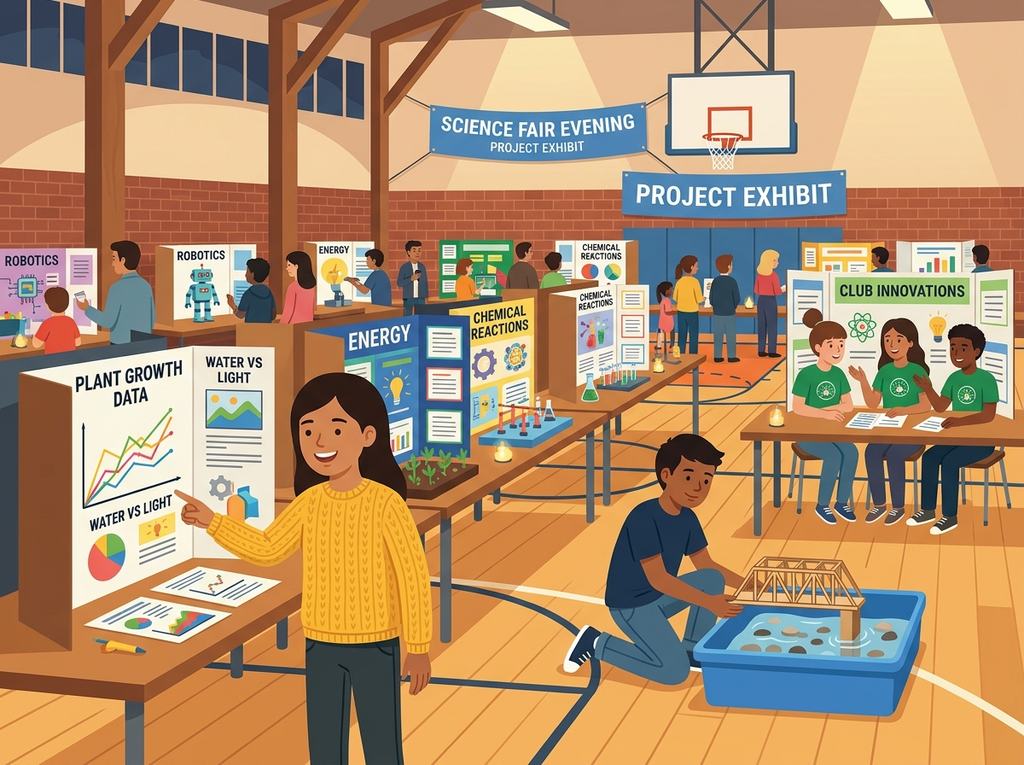
The picture shows a middle school gym on the evening of the science fair. Three long rows of tables run down the middle of the floor, and a folded poster board stands on every table.
At the table on the left, a girl in a yellow sweater points at a colorful line graph on her science project poster titled 'Plant Growth Data'.
Beside her table, a boy kneels on the floor holding a wooden model bridge over a blue plastic tub filled with water and stones.
On the right, three students in matching green club shirts sit at a table working together in front of a tri-fold poster titled 'Club Innovations'.
In the background, other students and visitors view project tables with posters and chemical flasks, and a banner hangs under the basketball hoop reading 'Science Fair Evening'.
Look closely at the picture. Then answer the three short questions one at a time, out loud, and give a longer spoken answer to the last one. Do not write anything down.
Who is pointing at the graph on her poster? What is the boy beside the plastic tub doing? When does this scene take place? Now give a longer answer: describe what is happening in the gym, and explain what you think it would feel like to be one of the students standing at a table tonight.
Answer the prompt aloud. After recording, listen back or try another take.
View the practice scoring rubric
| Level | What it looks like |
|---|---|
| 4 — Well developed |
|
| 3 — Moderately developed |
|
| 2 — Somewhat developed |
|
| 1 — Minimally developed |
|
Show a strong sample response
The girl in the yellow sweater is pointing at the graph on her poster.
He is kneeling beside the plastic tub of water, holding a wooden model bridge over the water and stones to test it.
It takes place in the evening during a school science fair exhibit.
Okay, so the whole school gym has been set up for the science fair evening. Down the center of the gym there are rows of tables with project tri-fold boards on them. On the left side, a girl wearing a yellow knit sweater is proudly pointing to a colorful line graph on her poster board, which is titled 'Plant Growth Data.' Right next to her table, a boy is kneeling down on the basketball court holding a wooden truss bridge over a blue plastic tub with water and stones, probably testing how strong the bridge is. Over on the right side, three students wearing matching green club shirts are sitting at a table with a display board that says 'Club Innovations,' reviewing papers and working together. In the background, other students and parents are walking around looking at projects about energy and chemical reactions with beakers and test tubes, and a big blue banner hangs from the basketball hoop reading 'Science Fair Evening.'
If I were standing at a table tonight, I would probably feel excited but also a little nervous. You spend weeks building your model or growing your plants, so you hope your demonstration works properly when people come to look at it, but it also feels great to show what you learned.
The three short answers are correct and spoken in full sentences. The longer answer navigates across the gym logically—from the plant growth display on the left, to the bridge demonstration, to the club innovations table on the right, and the exhibits in the background—before sharing a well-reasoned personal reflection.
What to look for
- This is a spoken task. Have the student talk, not write, and record it on a phone if you want to listen back together afterwards.
- Ask the three short questions one at a time and wait. Reading all four out at once turns it into a memory test rather than a speaking task.
- Listen for organization in the long answer. Working across the room in some order is worth more than naming a greater number of objects at random.
- Hesitation is not by itself a weakness at this age. What matters is whether a listener who has not seen the picture could picture the gym from the response.
- Nothing you do here produces a level. Use the rubric to decide what to practice next — on the real test a trained scorer listens to the recording and makes that judgment.
Read next
- ELPAC Speaking Test: Task Types & Rubrics: The Speaking domain asks a student to answer out loud, one to one with a test examiner who scores each answer on the spot. Here is what each task type involves, how answers are scored, and how to practice.
- How to Prepare for the ELPAC: Effective ELPAC preparation is about steady daily language development rather than frantic test cramming. Here is a practical, domain-by-domain guide for parents and teachers.
- ELPAC Scores Explained: A Summative ELPAC report gives an overall performance level from 1 to 4, plus separate results for oral language and written language. Here is what each part means, and what it does not mean.
This is an independent study resource. It is not affiliated with, endorsed by, or connected to the California Department of Education or the official ELPAC program. All questions here are original practice material written to match the published task formats.