ELPAC speaking prompts and practice for grades 3–5
Speaking prompts with a rubric based on the published scoring guides, plus sample responses and optional personalized feedback. Not scored here — speaking is scored by a person on the real test.
Record your answer and play it back—no typing needed. Where supported, turn on automatic transcription to get personalized feedback on what you said. The feedback reads only the transcript, so it cannot judge pronunciation, and it is not an official ELPAC score — on the real test, speaking is scored against a rubric.
Prompt 1 of 6 — Talk About a Scene — about 2 minutes on the real test
Look closely at the picture, then speak your answer aloud.
Recess on the Playground
Read image description
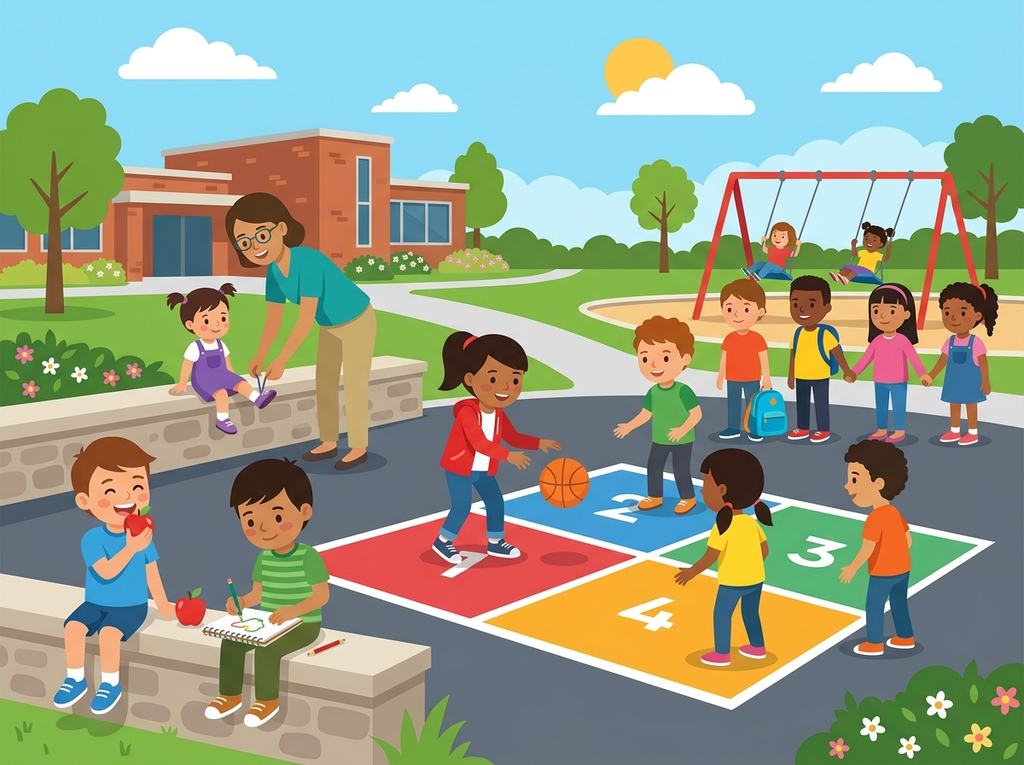
The picture shows a school playground during recess on a sunny day.
In the middle, four students are playing four square on a painted court. A girl in a red jacket has just hit the ball, and the other three are looking up at it.
On the left, two boys are sitting on a low wall. One is eating an apple. The other is drawing in a notebook that is open on his knees.
Behind the wall, a teacher with a whistle around her neck is bending down to tie a younger student's shoelace.
On the right, six students are standing in a line, waiting for a turn on the swings. A backpack and a paper lunch bag are on the ground near the fence, and a small brown bird is standing next to the lunch bag.
Look at the picture. Then talk about it aloud for about one minute. Do not write your answer down.
Tell what is happening in this picture. Describe the people and what they are doing.
Answer the prompt aloud. After recording, listen back or try another take.
View the practice scoring rubric
| Level | What it looks like |
|---|---|
| 4 — Well developed |
|
| 3 — Moderately developed |
|
| 2 — Somewhat developed |
|
| 1 — Minimally developed |
|
Show a strong sample response
This picture is a playground at a school, and I think it is recess time because everybody is outside. The sun is out, so it looks like a warm day.
In the middle there are four kids playing four square. The girl with the red jacket just hit the ball and the other three are looking up at it, so maybe she is winning the game.
On the left side two boys are sitting on a low wall. One boy is eating an apple and the other one is drawing something in his notebook. They are not playing, they are just resting and talking.
Behind them there is a teacher with a whistle. She is bending down to tie the shoe of a little kid, probably so he does not trip when he runs.
On the other side there is a line of kids waiting for the swings, and I counted six of them. And near the fence there is a backpack and a lunch bag on the ground, and a bird is standing right next to the lunch bag. I think that bird wants to eat somebody's food, so somebody should move the bag.
It opens by naming the whole scene, then moves across it in an order a listener can follow, and every group of people gets an action verb. The two small inferences - she is winning, the bird wants the food - go beyond listing, which is what the top level of this task rewards.
What to look for
- This task is spoken. Have the student talk rather than write, and record it on a phone if you want to listen back together afterwards.
- Listen for whether the description is organized. Moving across the scene in some order - left to right, or middle then edges - is worth more than naming more objects at random.
- Count how many different people or groups get mentioned. Students who describe only the ball game are giving a partial answer even when their English is good.
- Prompt once with 'what else do you see?' if the student stops early, and note that you had to. On the real test the examiner may prompt too.
- Hesitation is normal and is not by itself a weakness. What matters is whether the listener can follow the picture from the description.
Read next
- ELPAC Speaking Test: Task Types & Rubrics: The Speaking domain asks a student to answer out loud, one to one with a test examiner who scores each answer on the spot. Here is what each task type involves, how answers are scored, and how to practice.
- How to Prepare for the ELPAC: Effective ELPAC preparation is about steady daily language development rather than frantic test cramming. Here is a practical, domain-by-domain guide for parents and teachers.
- ELPAC Scores Explained: A Summative ELPAC report gives an overall performance level from 1 to 4, plus separate results for oral language and written language. Here is what each part means, and what it does not mean.
This is an independent study resource. It is not affiliated with, endorsed by, or connected to the California Department of Education or the official ELPAC program. All questions here are original practice material written to match the published task formats.