ELPAC writing prompts and practice for grade 2
Writing prompts with a rubric based on the published scoring guides, plus sample responses and optional personalized feedback. Not scored here — writing is scored by a person on the real test.
Write your response in the editor. You can see your word count, use the optional timer, save a draft in this browser, ask for personalized feedback, and compare your writing with the rubric and sample response. It is not scored here — on the real test a trained scorer rates writing.
Prompt 1 of 6 — Write a Story Together with Scaffolding — about 8 minutes on the real test
Look at the picture with your child and talk about it together before either of you writes anything.
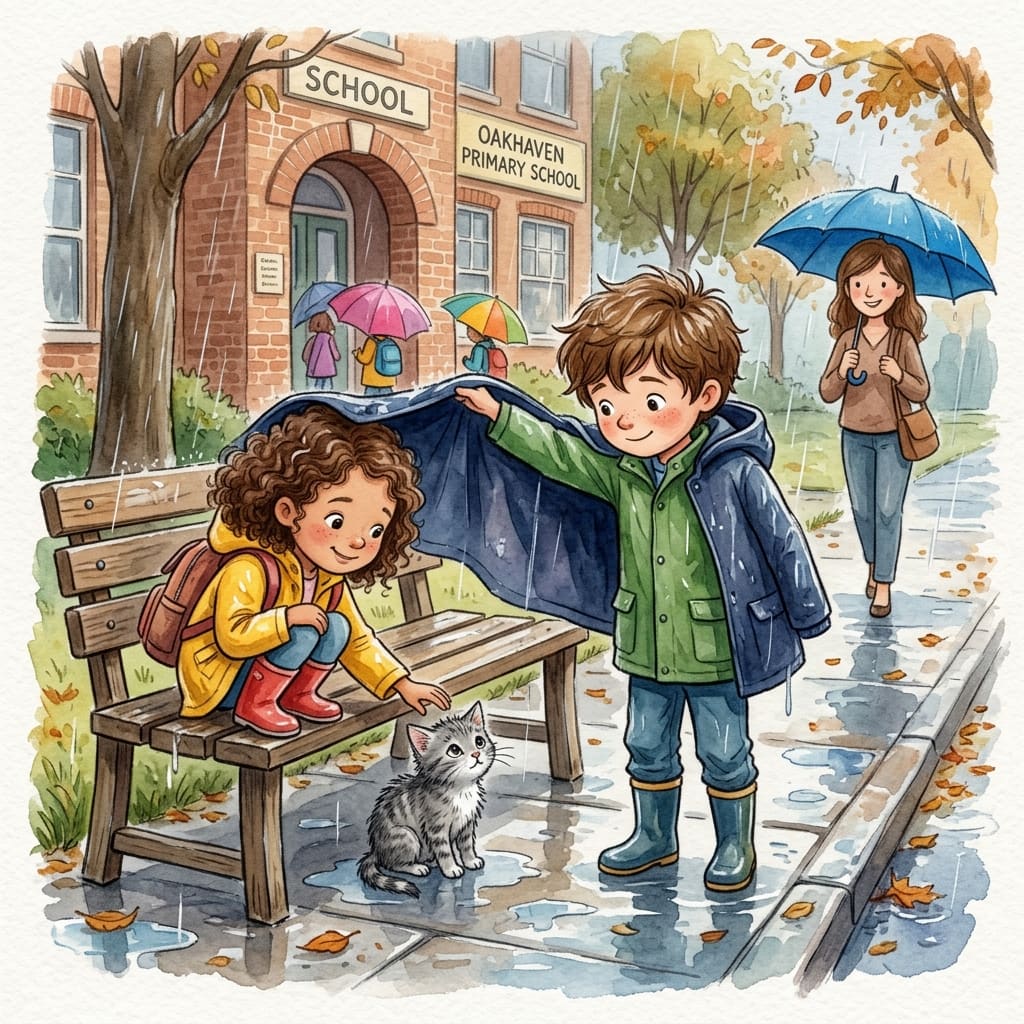
The Kitten by the Bench
Read image description
The picture shows the sidewalk outside a brick school on a rainy fall day. The sign on the school says Oakhaven Primary School.
Two second graders, Priya and Elias, are next to a wooden bench. A small gray kitten with wet fur sits on the wet sidewalk at the front edge of the bench, looking up.
Priya, in a yellow raincoat and red boots, is crouching on the bench with her backpack on. She is reaching one hand down toward the kitten.
Elias, in a green raincoat and boots, is holding his navy blue jacket up over Priya and the bench, like a roof to keep off the rain.
Behind them, children with umbrellas walk toward the school door, and a woman with a blue umbrella is walking down the sidewalk toward them.
Do this one together. On the real test an examiner builds the story with the student and writes it down, so take that role. Look at the picture together, ask your child what happens next, and write their words on paper as they say them — your child is not expected to do the writing. Ask one question at a time, then wait, and keep your own ideas for the story to yourself.
Look at the picture. Tell a story about what happens next. Who helps the kitten? What do they do? How does your story end?
View the practice scoring rubric
| Level | What it looks like |
|---|---|
| 4 — Well developed |
|
| 3 — Moderately developed |
|
| 2 — Somewhat developed |
|
| 1 — Minimally developed |
|
Show a strong sample response
Priya and Elias saw a little cat by the bench. It was raining on it and it was shaking because it was cold.
Priya said come here kitty, we are not going to hurt you. But the cat was too scared and it did not come out. So Elias put his jacket over the bench like a roof, and then the rain stopped hitting the cat. The cat smelled his shoe and then it came out.
Then the lady with the umbrella came and she said hey, that is my neighbor cat, it ran away this morning. So they all walked to the neighbor house and Elias carried the cat inside his jacket. The neighbor was so happy. She said the cat name is Pepper and she gave them each a cookie.
This is strong for seven because it is a story and not a description: the kitten is frightened, Elias does something about it, and then someone turns up who explains where the kitten belongs. The parts that are not in the picture — Pepper, the neighbor, the cookies — are the child’s own invention, which is exactly what this task is asking for.
What to look for
- Write down what your child actually says, including the parts that are not quite right. The point is to see their language, and tidying it as you go hides the very thing you are trying to look at.
- Ask questions rather than supplying ideas. "What happened next?" and "What did she say?" move a story along; "Maybe they took it home" hands your child your story instead of theirs.
- Wait longer than feels comfortable after each question. Seven-year-olds often need five or six seconds to start, and filling that silence usually ends the story early.
- Read the finished story back aloud and ask whether anything is missing. Children this age often add their best detail on the second pass.
- Nothing here produces a score or a level. On the real test a trained examiner makes that judgment — use the rubric to notice what your child can already do and pick one thing to work on.
Read next
- How to Prepare for the ELPAC: Effective ELPAC preparation is about steady daily language development rather than frantic test cramming. Here is a practical, domain-by-domain guide for parents and teachers.
- ELPAC Scores Explained: A Summative ELPAC report gives an overall performance level from 1 to 4, plus separate results for oral language and written language. Here is what each part means, and what it does not mean.
This is an independent study resource. It is not affiliated with, endorsed by, or connected to the California Department of Education or the official ELPAC program. All questions here are original practice material written to match the published task formats.