ELPAC speaking prompts and practice for grades 11–12
Speaking prompts with a rubric based on the published scoring guides, plus sample responses and optional personalized feedback. Not scored here — speaking is scored by a person on the real test.
Record your answer and play it back—no typing needed. Where supported, turn on automatic transcription to get personalized feedback on what you said. The feedback reads only the transcript, so it cannot judge pronunciation, and it is not an official ELPAC score — on the real test, speaking is scored against a rubric.
Prompt 1 of 8 — Talk About a Scene — about 3 minutes on the real test
Look closely at the picture, then speak your answers aloud.
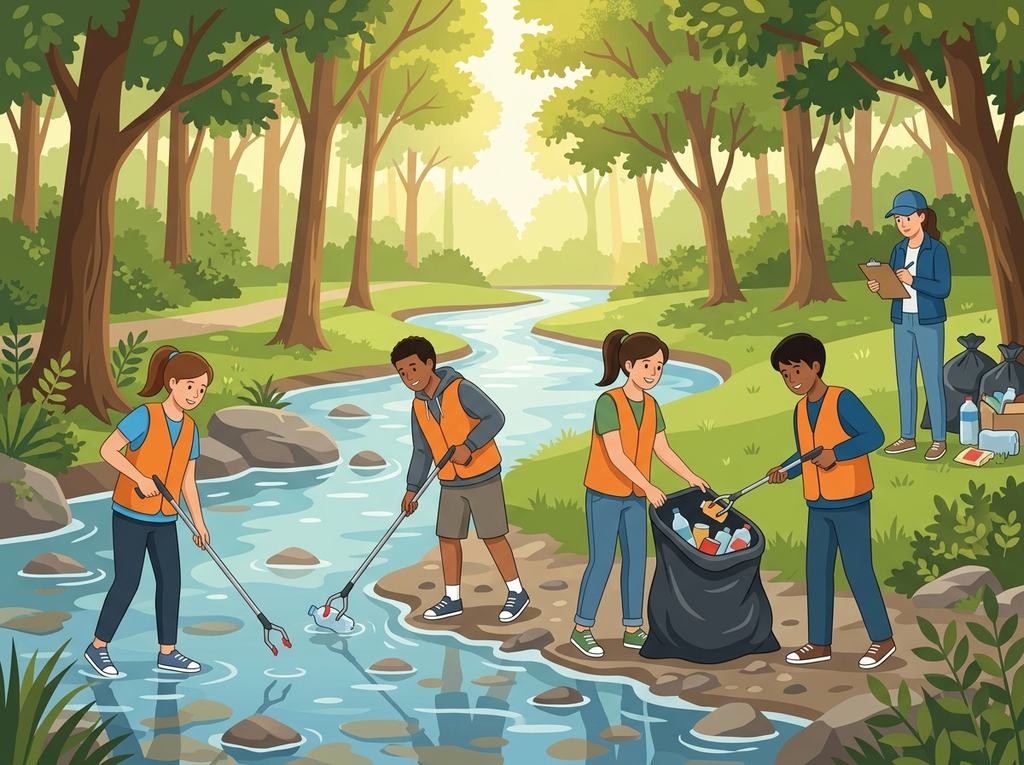
Volunteer Morning at Mariposa Creek
Read image description
The picture shows a Saturday morning volunteer event beside a creek in a wooded park.
In the shallow creek, two high school students in matching orange vests use long grabber tools to pick plastic bottles and cans out of the water.
On the grassy bank, two other students in orange vests work together to collect the litter: a girl holds open a large black trash bag while a boy drops empty cans into it with a grabber tool.
On the right, a supervisor wearing a blue cap and blue jacket stands near several filled trash bags, writing notes on a clipboard.
In the background, the creek winds through tall green trees under a bright morning sky.
Look closely at the picture. Then answer the three short questions aloud, one at a time, and stop after each one. After that, give the longer answer. Speak, do not write.
Who is taking notes on a clipboard on the right? What are the four students in orange vests doing? When is this event taking place? Now give a longer answer: describe what is happening in this scene, and explain what you think this group is trying to accomplish and why it might matter to the community.
Answer the prompt aloud. After recording, listen back or try another take.
View the practice scoring rubric
| Level | What it looks like |
|---|---|
| 4 — Well developed |
|
| 3 — Moderately developed |
|
| 2 — Somewhat developed |
|
| 1 — Minimally developed |
|
Show a strong sample response
The supervisor on the right wearing the blue jacket and cap is taking notes on a clipboard.
The four students in the orange vests are working in the creek and on the bank to collect litter with grabber tools and a trash bag.
It is happening on a Saturday morning in a wooded park.
So, the whole picture shows a volunteer cleanup along a creek. Four high school students in matching orange vests are working together to clean litter out of the water and off the bank. Two of them are standing right in the shallow stream, using long reacher tools to pick up plastic bottles and debris from between the rocks. Up on the bank, a girl is holding open a big black garbage bag while another boy drops empty cans into it with his grabber tool. Over on the right, an adult supervisor in a blue jacket and blue cap is tracking their work on a clipboard next to several full trash bags and supplies. Behind them, the creek winds peacefully through tall green trees in the sunlight.
What this group is trying to accomplish is cleaning up trash that washed down into the waterway so it does not pollute the park or harm fish and wildlife downstream. For the town, volunteer cleanups like this keep public parks clean and safe for everyone while saving city resources.
The three short answers are complete sentences that reflect the details in the illustration, and the long answer is organized clearly across the water and the bank. The reasoning at the end connects the grabber tools, trash bags and natural setting to environmental conservation.
What to look for
- This is a spoken task. Have the student talk, not write, and record it on a phone if you want to listen back together afterwards.
- Keep the three short questions short. Stopping after each one, the way the real test does, is part of what is being practiced, and students who read all four at once tend to merge them.
- Listen for organization in the long answer. Moving through the scene in some order is worth more than naming more objects at random.
- Notice whether the explanation is tied to the picture. At this band, the difference between an adequate answer and a strong one is usually evidence, not vocabulary.
- Nothing here produces a level. A trained scorer does that on the real test; use the rubric to name what went well and pick one thing to try again.
Read next
- ELPAC Speaking Test: Task Types & Rubrics: The Speaking domain asks a student to answer out loud, one to one with a test examiner who scores each answer on the spot. Here is what each task type involves, how answers are scored, and how to practice.
- How to Prepare for the ELPAC: Effective ELPAC preparation is about steady daily language development rather than frantic test cramming. Here is a practical, domain-by-domain guide for parents and teachers.
- ELPAC Scores Explained: A Summative ELPAC report gives an overall performance level from 1 to 4, plus separate results for oral language and written language. Here is what each part means, and what it does not mean.
This is an independent study resource. It is not affiliated with, endorsed by, or connected to the California Department of Education or the official ELPAC program. All questions here are original practice material written to match the published task formats.